The Complete Guide to Getting Started
So you spent all last summer seeing everyone’s European vacations on Instagram and now you’re wondering how you can maximize your adventures without breaking the bank. Welcome to the world of travel credit cards – where your everyday spending can fuel your next vacation. But with dozens of cards claiming to be the “best,” how do you know where to start?
The truth is, there’s no one-size-fits-all answer. The right card for you depends entirely on how and where you travel. Let me break down the key factors to help you make the smartest choice for your first travel credit card.
Step One: Pick Your Ecosystem
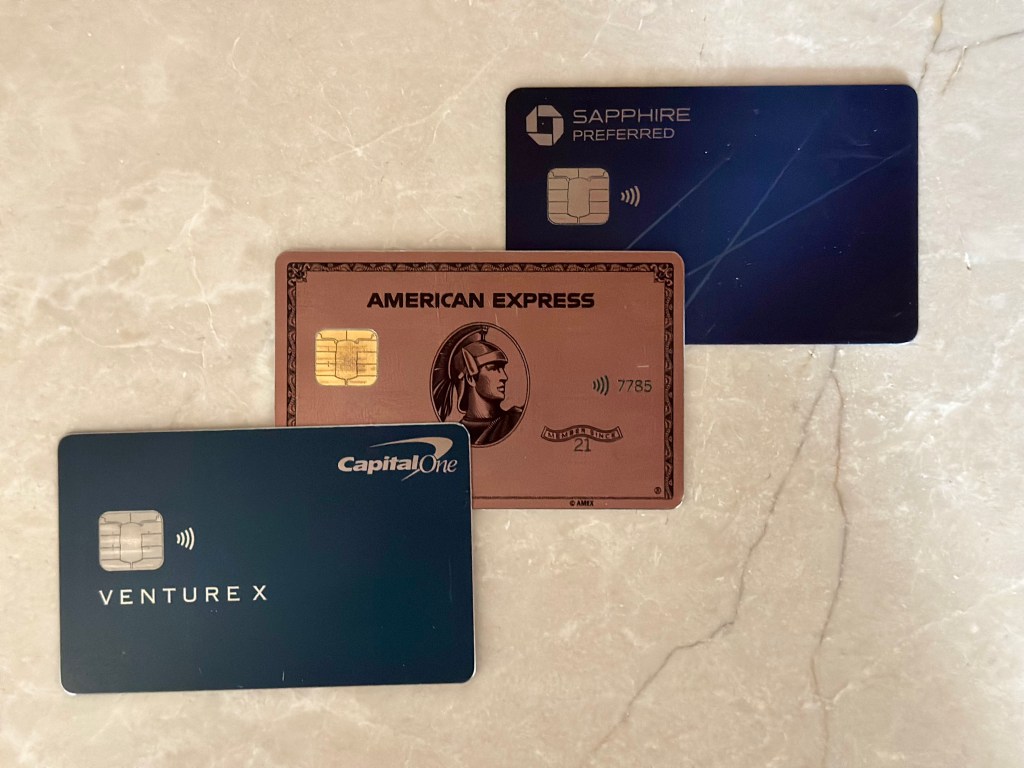
Before diving into specific cards, you need to choose which credit card “ecosystem” aligns with your travel goals. Each major issuer – Chase, Amex, Capital One, and Citi – offers a family of cards that work together, allowing you to pool points and maximize earning potential.
Here’s the strategic approach: first pick your ecosystem, then decide if you need the premium version or if a base-level card meets your needs.
The base-level cards (like Chase Sapphire Preferred, Amex Green/Gold, or Capital One Venture) offer lower annual fees but still give you access to the same valuable points currencies. The premium versions (Chase Sapphire Reserve, Amex Platinum, Capital One Venture X, Citi Strata Elite) come with higher fees but add perks like lounge access, statement credits, and enhanced travel protections.
Your decision should be based on whether you’ll actually use those premium benefits enough to justify the extra cost. Many travelers find the base cards provide 80% of the value at 40% of the cost.
Domestic vs International Travel: Your Destination Shapes Your Strategy
Domestic Travel: Chase Points Reign Supreme
If you’re primarily exploring the United States, Chase Ultimate Rewards points should be at the top of your list. Here’s why Chase points are perfect for domestic travelers:
The Hyatt Advantage: Chase points transfer 1:1 to World of Hyatt, which consistently offers the best value hotel redemptions in the industry (even after the May 2026 devaluation). Though your most premium, top tier category hotels in the Hyatt portfolio will set you back a bit, your base level Hyatt Places and Houses can go for as low as 6,000 points per night.
Airline Flexibility: Chase points also transfer to Southwest (perfect for domestic flights) and United, plus numerous other partner airlines. This gives you maximum flexibility for domestic award bookings while leaving you with plenty of international options.
Points Boost: Chase’s Points Boost feature allows you to make slightly better than 1 cent per point use on your points earned, which is particularly valuable for domestic redemptions where you might not find premium award availability.
Amex as a Solid Second: American Express Membership Rewards points come in second for domestic travel. You won’t get as much value from their hotel partners, Hilton and Marriott, but they do have a larger footprint in most areas and there are roundabout ways to book domestic travel through their extensive airline partner network.
The reality is that domestic travel often favors a hybrid approach: paying cash for flights (which are typically cheaper domestically) and using points for hotel stays where you can extract serious value.
International Travel: Multiple Players in the Game
For international adventures, the playing field levels out significantly. Chase, Amex, Capital One, and Citi points are all valuable for international travel. In my opinion, Amex has a slight edge due to the number of airline partners and alliances their points provide access to.
Amex’s Global Reach: With transfers to airlines in Star Alliance, oneworld, and SkyTeam, Amex gives you the most options for international award flights.
Citi’s American Airlines Connection: Citi points transfer to American Airlines, which offers fantastic international award availability through their extensive partner network when space is available.
Capital One’s Simplicity: Capital One miles transfer to multiple partners at favorable rates, making them incredibly versatile for international travel.
Hotels vs Airfare: Where Your Points Go Furthest
Hotels: Chase Takes the Crown
This one’s not even close. Chase points transferring to Hyatt represent the best value in hotel award redemptions, period. Hyatt’s award chart offers consistent, excellent value whether you’re booking a Park Hyatt in Tokyo or an Alila resort in Bali. Again, yes, even after the May 2026 devaluation.
Airfare: Citi’s American Airlines Sweet Spot
For flights, Citi’s partnership with American Airlines creates some incredible opportunities. AA’s award chart has sweet spots for both domestic and international travel, especially when booking partner airlines. However, award availability can be limited, so flexibility in your travel dates is key.
The Loyalty Card Strategy
If you consistently fly one airline or stay with one hotel chain, co-branded credit cards might be your best bet. Especially these days, as more US airlines are giving their best award options and rates to members who hold one of their credit cards. You’ll earn more points per dollar spent, often get elite status faster, and enjoy perks like free checked bags or room upgrades.
But remember, not all loyalty programs are created equal. Delta SkyMiles and Marriott Bonvoy points are significantly less valuable for getting free flights and hotels than American Airlines miles or Hyatt points. But if you don’t fly American or stay at Hyatt frequently, you’re not going to reap the added value of those points regardless. This is a personal decision, so choose wisely.
The Ancillary Benefits That Actually Matter
Lounge Access: Location, Location, Location
Capital One Venture X offers the practical lounge access, especially if you’re in the DC area. With lounges in DCA, IAD, Denver, Dallas, Las Vegas, and JFK, they’ve strategically placed lounges in major connection hubs.
Chase Sapphire Reserve lounges are super premium but limited. With locations only in NYC, Boston, Philadelphia, LaGuardia, and Washington Dulles (technically the Etihad lounge), the footprint is not as widespread. However, the 2025 refresh brought significant changes: the annual fee increased to $795, but added valuable new benefits including enhanced dining and entertainment credits.
The 2025 Chase Sapphire Reserve refresh also includes:
- $300 annual travel credit
- Up to $120 TSA PreCheck/Global Entry credit every four years
- Enhanced dining and entertainment benefits through partnerships
- Complimentary IHG One Rewards Platinum Elite Status
Amex Centurion Lounges offer the most locations but suffer from overcrowding issues, as do all lounges these days. However, the 2025 refresh positioned Amex Platinum as potentially having the best benefits of any premium card despite the high cost.
The 2025 Amex Platinum refresh (effective September 18, 2025) brings major enhancements with the annual fee increasing to $895 but offering over $3,500 in annual benefits:
- Up to $400 annually in Resy dining credits ($100 per quarter)
- Up to $600 in Fine Hotels & Resorts (FHR) and Hotel Collection annually (two $300 semi-annual credits)
- $200 per year in Uber/Uber Eats credits and complimentary Uber One membership
- Continued Global Entry/TSA PreCheck credits, streaming and digital entertainment credits
Balancing Ease of Use vs Maximum Value: My Strategy
- Capital One Venture X
If you want to maximize earning potential, premium benefits, while minimizing the annual fee, the Capital One Venture X is your best choice. Here’s the math that makes it my favorite premium card:
- 2x points on all purchases (the highest earning rate for a general travel card)
- $300 annual travel credit (easy to use in their portal)
- 10,000 bonus points annually (worth $100 in cash and more in transfers)
The annual fee is $395, so before you even factor in lounge access, Global Entry credits, and travel protections, the card essentially pays for itself. The trade-off? You’ll need to transfer points to partners for maximum value rather than booking directly through Capital One’s portal. But for savvy reward hunters, especially frequent international travelers, the higher earning rate more than compensates for this complexity.
- Chase Sapphire Preferred
This was my first travel card, and it’s the card I recommend to most people as their first travel card. Having access to Chase points has been a game changer for me and my travel habits. I use them primarily to transfer to Hyatt, but if I need a few extra to transfer to Southwest, Air France, or any other partner, they’re there for me. I have saved thousands of dollars on hotels in particular because of the valuable transfer partner that is Hyatt. You can see some of my favorite and most valuable redemptions here, when I saved thousands during a trip to Japan in peak cherry blossom season. And there are very few hoops to jump through to use the points, so beginners really benefit from learning the basics by being in this ecosystem.
My Bottom Line Recommendation
Here’s my step-by-step approach for choosing your first travel credit card:
Step 1: Choose Your Ecosystem
- Chase if you prioritize domestic travel and hotel value
- Amex if you travel internationally frequently
- Capital One if you want simplicity and high earning rates
- Citi if American Airlines and OneWorld Partners fit your travel patterns
Step 2: Pick Your Level
- Start with base cards (Chase Sapphire Preferred, Amex Gold, Capital One Venture) if you’re new to travel cards or travel occasionally
- Upgrade to premium (Chase Sapphire Reserve, Amex Platinum, Capital One Venture X) only if you’ll use the lounge access, credits, and premium perks enough to justify the higher annual fees
For most first-time users, I’d specifically recommend:
- Chase Sapphire Preferred ($95 annual fee) if you want to test Ultimate Rewards
- Capital One Venture ($95 annual fee) if you want simplicity and solid earning
- Amex Gold ($325 annual fee) if the dining and grocery credits work for your spending
Only consider the premium versions if you travel frequently enough to maximize lounge access and can actually use the various statement credits they offer.
The key is to be honest about your travel patterns and spending habits. Your spending habits on each card may also change based on the travel you’re planning (for example, you know you want to save up for an all inclusive Hyatt resort in Mexico, so you prioritize your Chase points over Amex and capital One for a while). Don’t be swayed by flashy benefits you’ll never use (would you really be spending $75 every quarter at Lululemon if the Amex Platinum wasn’t giving you that benefit?) Start with a card that matches your actual lifestyle, then consider adding others to your wallet as your travel increases.
Remember, the best travel credit card is the one you’ll actually use and can maximize. Start simple, learn the ropes, and then you can always optimize your strategy as you become more sophisticated in the points and miles game.


Leave a comment